
São João in Porto: Plastic Hammers and the European Portuguese You Need
Published on 2026-06-22
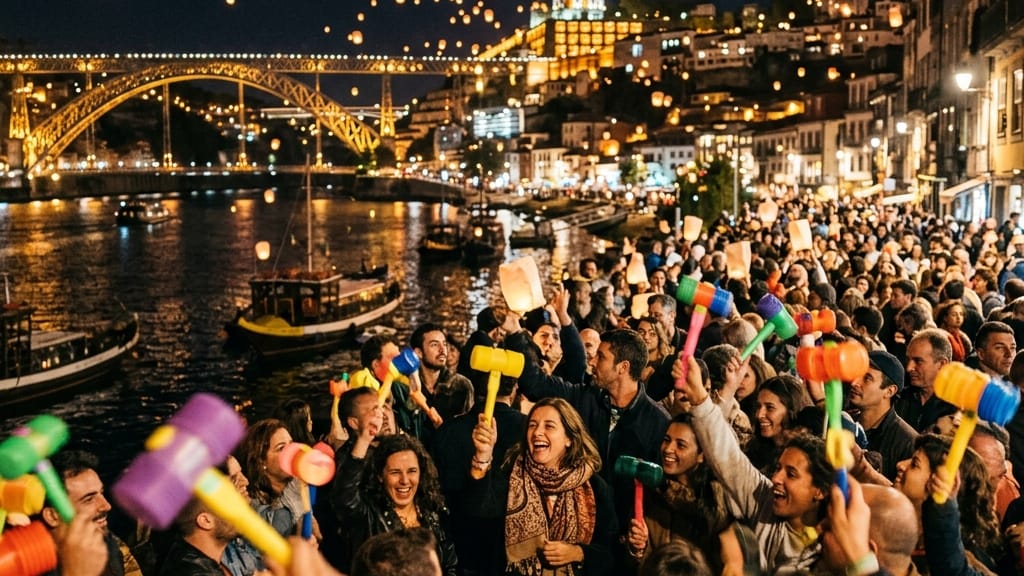
Tomorrow night, a complete stranger in Porto is going to hit you on the head with a plastic hammer. This is not a threat. It is a blessing.
The night of June 23rd is São João (Saint John), Porto's answer to Lisbon's Santo António — and many Portuguese will tell you, quietly, that it's the better party. The whole city pours into the streets, grills appear on every corner, hot-air balloons drift over the river, and at midnight the sky above the Douro explodes with fireworks. If you're learning European Portuguese, it's also a full-immersion classroom that happens to serve sardines.
We covered Lisbon's festival in our guide to the Santos Populares. São João runs on the same saint-month energy but with its own rituals, its own vocabulary, and — crucially — its own word for beer.
What Actually Happens on São João?
The party starts in the late afternoon of June 23rd and runs until sunrise on the 24th (a city holiday in Porto). The historic riverside neighborhoods — a Ribeira, as Fontainhas, Miragaia — get the biggest crowds, but every bairro has its own corner party with a grill and a sound system.
The night has a script:
| Time | What happens |
|---|---|
| Evening | Grilled sardines, caldo verde, and the hammering begins |
| Around midnight | Fireworks over the Douro from the Dom Luís I bridge |
| After midnight | Balões de São João — paper hot-air lanterns released into the sky |
| Small hours | Jumping over bonfires, dancing, walking to the sea at Foz |
| Sunrise | The hardcore finish with a swim at Praia dos Ingleses. You don't have to. |
Why Is Everyone Hitting Each Other with Hammers?
The signature ritual of São João is bopping strangers on the head with um martelinho — a squeaky plastic hammer. The tradition descends from an older (and stranger) one: tapping people with alho-porro, a flowering leek stalk, which you will still see waved around by traditionalists. Both are good luck. Both are consensual chaos.
The etiquette, such as it is:
- Anyone may hammer anyone. A gentle bop on the head, ideally with eye contact and a grin.
- The correct response is to laugh and bop back. "Feliz São João!" (Happy São João!) covers you in both directions.
- Buy your own martelinho from any street vendor — a couple of euros. Ask: "Quanto custa o martelinho?"
In Porto, Don't Order an Imperial
Here's the vocabulary trap that instantly marks you as a Lisbon tourist. In Lisbon, a draft beer is uma imperial. In Porto, it is um fino. Same beer, fierce regional pride — we wrote a whole guide to ordering beer in Portugal about exactly this divide.
"Era um fino e uma sardinha no pão, se faz favor."
("A draft beer and a sardine on bread, please.")
That sentence — with the soft, local era instead of quero — will carry you through the entire night. A few more lines worth having ready:
- "Está muita gente!" — There are so many people!
- "Onde é o fogo de artifício?" — Where are the fireworks?
- "Posso saltar a fogueira?" — Can I jump the bonfire? (Look before you leap. Literally.)
- "Bela festa!" — Great party!
Advertisement
The São João Vocabulary List
| Portuguese | English | Notes |
|---|---|---|
| o martelinho | little plastic hammer | The weapon of choice |
| o alho-porro | leek stalk | The original head-bopper |
| o balão de São João | paper lantern balloon | Released after midnight |
| a fogueira | bonfire | Jumped for luck |
| a sardinha assada | grilled sardine | Same star as in Lisbon |
| o caldo verde | kale and potato soup | The 3 a.m. course |
| um fino | draft beer (Porto) | Say imperial and they'll know |
| o fogo de artifício | fireworks | Midnight, over the Douro |
| a Ribeira | Porto's riverside quarter | Ground zero for the party |
| a cascata | nativity-style saint display | Miniature scenes in windows |
What Is Bonfire Jumping About?
São João absorbed much older midsummer-solstice rituals, and the fogueiras are the clearest survivor. Tradition says you jump over the bonfire an odd number of times — usually three — for luck and purification. In the old riverside neighborhoods, you'll see kids clearing small fires while grandmothers supervise with professional judgment.
Listen for the chant: "Salta!" (Jump!). The verb is saltar, and if a group waves you over, "salta, salta!" is your invitation. Jump small fires only, and remember that emergency-room Portuguese is a much harder lesson.
Three Listening Wins for Learners
São João is loud, fast, and Northern — the Porto accent swallows even more vowels than Lisbon's. Three things you can realistically catch:
- "Feliz São João!" — the all-night greeting. Reply with the same.
- "Era um fino." — listen at the beer stalls and you'll hear the imperfect-tense ordering ritual on repeat.
- "Cheira bem!" — "It smells good!" — usually shouted near a sardine grill, usually true.
Quick Questions
Is São João better than Santo António in Lisbon?
Ask a tripeiro (Porto native) and an alfacinha (Lisbon native) and enjoy the argument. São João is generally rowdier and more concentrated — one enormous night — while Lisbon's festival stretches across more of June.
Do I need to book anything?
No tickets — the street party is free. But book accommodation weeks ahead, expect restaurants to be full or closed for the night, and know that the metro runs all night on the 23rd while the city center closes to cars.
What do I do with the plastic hammer the next day?
Keep it. It squeaks, it's yours, and it's the cheapest souvenir in Portugal. Some households have a drawer of them, one per year, like rings in a tree.
Is June 24th a holiday everywhere in Portugal?
No — it's a municipal holiday in Porto, Braga, and a handful of northern towns. Lisbon works that day (they had their holiday on the 13th).
Heading north for the party? Get the food-ordering basics down first — our free European Portuguese lessons cover ordering food and drinks, greetings, and numbers, no signup required.
Advertisement
Start Learning Today
Join PortuTalk to unlock interactive lessons, listening exercises, and more.
Sign up for FreeNo credit card required.