Beijinhos: The Etiquette of Portuguese Greetings (Kisses & Handshakes)
Published on 2026-08-13
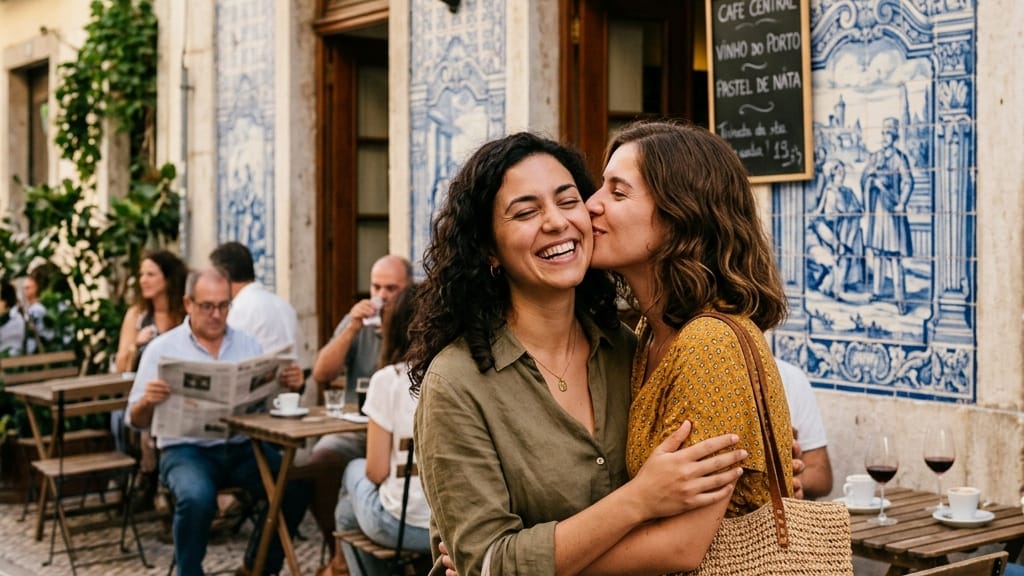
You're introduced to your Portuguese friend's mother. You extend a hand. She's already leaning in. There's a brief moment of diplomatic chaos — a hand pressed against a cardigan, a kiss landing somewhere near an ear — and you've just performed the foreigner's rite of passage: fumbling the beijinhos.
Greetings are the highest-frequency social ritual in any culture, and Portugal's come with precise unwritten rules about who kisses whom, how many times, and which words go with it. None of it is in your grammar book, all of it happens in the first three seconds of every encounter, and getting it smoothly right is worth more social credit than a whole verb tense. Here's the etiquette of European Portuguese greetings, decoded.
How Many Kisses, and Who Kisses Whom?
The standard greeting between friends, family, and friendly acquaintances is dois beijinhos — two light cheek kisses (often more air than contact), starting on the right cheek, so you both lean left first. The matrix of who does what:
| Situation | The greeting |
|---|---|
| Two women (friends/social) | Two kisses |
| Woman + man (friends/social) | Two kisses |
| Two men (most contexts) | Handshake, or hug/back-pat if close |
| Anyone, formal/professional | Handshake |
| Family, after long absence | Kisses plus a real hug |
| Children greeting adults | Kisses, taught from birth |
Useful physics: the "kiss" is cheek-to-cheek contact with a kiss sound beside the ear, not a lip landing. And the word itself — o beijinho, the diminutive of beijo (kiss) — already tells you the register: small, light, friendly, nothing dramatic.
Regional fine print: in some northern and more traditional settings, people may give just one kiss, and very formal older circles kiss less overall. When in doubt, mirror the other person's incoming trajectory — they decide, you cooperate.
When Do I Switch from Handshake to Beijinhos?
The transition is the subtle part. First meetings in professional or formal contexts get um aperto de mão (a handshake). But socially, the kiss arrives surprisingly early — often at the first introduction, if it's friends-of-friends at a dinner table. The reliable signals:
- If you're introduced through friends in a social setting, expect kisses immediately, often with the phrase "Dá cá dois beijinhos!" (Come here, give me two kisses!)
- If the other person says their name while extending a hand, shake it.
- The upgrade moment is frequently explicit: after a friendly first meeting, the goodbye becomes kisses even when the hello was a handshake.
The deeper register question — when someone stops being a senhora and becomes tu — runs on the same social current, and we've mapped that minefield in our guide to tu vs. você etiquette. The greetings and the grammar shift together: handshake people get o senhor; beijinhos people are usually on their way to tu.
Advertisement
What Do I Say While All This Is Happening?
The verbal layer, from formal to familiar:
- "Muito prazer." — A pleasure to meet you. (First introductions, usually with the handshake.)
- "Olá, tudo bem?" — Hi, all good? (The universal social greeting. The expected answer is "Tudo, e contigo?" — all good, and you? — regardless of how you actually are.)
- "Então, tudo bem?" — So, how's it going? (Between people who already know each other; the então does the warmth.)
- "Boa tarde." — Good afternoon. (Formal contexts, shops, strangers — and note Portugal switches to boa tarde at lunchtime, earlier than foreigners expect.)
- "Como está?" / "Como estás?" — How are you? (formal / informal — the verb ending carries the relationship.)
And the goodbyes, where Portuguese shines: "Até já" (see you in a bit), "Até logo" (see you later today), "Até amanhã" (see you tomorrow), and the gloriously noncommittal "Até qualquer dia" (see you... someday). Phone calls and messages between friends close with "beijinhos" itself — the kisses, sent verbally. A text ending in bjs is the compressed version, the Portuguese xx.
The Situations That Confuse Everyone
Arriving at a dinner party: you greet everyone individually — kisses or handshakes around the entire table, even if it's twelve people and your food gets cold. Skipping the round is genuinely rude. The same applies when leaving, which is why Portuguese goodbyes take twenty minutes (there's a phrase for the phenomenon: a despedida à portuguesa is the opposite of an Irish exit).
The workplace: colleagues who are friendly do beijinhos on arrival and departure in many offices, especially between women — but client meetings stay handshake territory. Follow the local weather.
Greeting children: kisses, always, and they've been trained to offer the cheek since infancy. A Portuguese grandmother will instruct a shy child: "Dá um beijinho ao senhor!" (Give the gentleman a kiss!)
When you're sick: the polite opt-out exists — lean back, raise a hand, say "Estou constipado/a!" (I have a cold!) and you'll get an understanding nod and a wave instead. The ritual matters, but so does the excuse mechanism.
Quick Questions
What if I go for the wrong greeting?
Nothing happens. The hand-versus-cheek fumble is so common it's practically its own tradition, and laughing it off — "Ainda estou a aprender!" (I'm still learning!) — converts the fumble into charm. The only real error is recoiling from an incoming beijinho; commitment beats accuracy.
Do men really never kiss other men?
Between most adult men it's a handshake or a hug with back pats — but close friends and family members do kiss in many families, especially across generations (sons kiss fathers, uncles, grandfathers). Default to the handshake and let the other man set the warmth level.
Is it two kisses everywhere in Portugal?
Two is the standard nearly everywhere, but you'll meet one-kiss habits in parts of the north and in older formal circles. Spain's two kisses start on the opposite cheek, which is why Iberian cross-border greetings occasionally produce accidental nose collisions.
What does "beijinhos" mean at the end of a message?
Literally "little kisses" — functionally "love / xx". Standard between friends and family, including men writing to female friends. Reserve "beijo" (singular, no diminutive) for actual romance; the diminutive is doing real grammatical work there.
Now you know what to do with your face — for what to do with your verbs, start with our free greetings lesson, and browse the rest of the free European Portuguese lessons. Beijinhos.
Advertisement
Start Learning Today
Join PortuTalk to unlock interactive lessons, listening exercises, and more.
Sign up for FreeNo credit card required.